The Co-Living Matrix Blog
Actionable advice on shared living, PCS transitions, single parenting co-housing, and roommate verification.

Roommates Charlotte NC: Finding Community, Friendship, and More Meaningful Moments as Moms
Motherhood is full of little moments that become lifelong memories. From decorating pumpkins and visiting fall festivals to watching little ones run from house to house on Halloween, these experiences often become even more special when shared with someone who understands the joys and challenges of raising children.For moms looking for a fresh start, Roommates Charlotte NC can be about more than finding an available bedroom. It can be an opportunity to find a compatible living arrangement, build friendships, and create a supportive environment where both moms and children feel at home.Why Moms Are Looking for Roommates in CharlotteRaising children takes a village, but building that village isn't always easy. Between work, childcare, household expenses, and busy schedules, many mothers are looking for practical ways to make everyday life a little easier.Finding another mom to share a home with can offer the opportunity to split housing expenses, coordinate routines, and enjoy the companionship of someone who understands the realities of parenting.Of course, every household is different. The best roommate arrangement starts with shared expectations, compatible lifestyles, and open conversations about parenting boundaries, finances, chores, and personal space.When those pieces fall into place, a shared home can become more than a cost-saving solution. It can be a place where friendships grow naturally.The Magic of Trick-or-Treating TogetherOne of the sweetest parts of finding a mom roommate is getting to share the little traditions that make childhood memorable.Imagine two moms getting their children dressed in adorable Halloween costumes, taking pictures before heading outside, and walking through the neighborhood together as the kids excitedly collect candy.There is something special about having another mom beside you who understands why you want one more picture, why you're bringing extra snacks, or why a simple evening of trick-or-treating feels like such a big deal.The children get to enjoy the excitement together, while the moms create memories of their own. What might have been an ordinary Halloween can become a tradition everyone looks forward to each year.And Halloween is only the beginning.Making Everyday Moments More MeaningfulSharing a home with another mom can open the door to countless little experiences that make life feel fuller.Think about:Weekend adventures: Exploring Charlotte parks, playgrounds, and family-friendly events together.Holiday traditions: Decorating for Christmas, baking cookies, or planning Easter egg hunts.Simple evenings at home: Sharing dinner while the children play nearby.Milestone celebrations: Taking pictures on the first day of school, celebrating birthdays, and cheering on new accomplishments.Mom-to-mom support: Having someone nearby who understands the beautiful, exhausting, and sometimes unpredictable parts of parenting.These moments don't have to be elaborate or expensive. Sometimes, the most meaningful memories come from simply having someone to share them with.Finding the Right Mom Roommate in Charlotte, NCIf you're searching for roommates in Charlotte, NC, and hoping to find another mother who values both affordability and connection, start by thinking about what would make a shared home work for your family.Consider whether your schedules align, how you feel about shared spaces, what your expectations are around guests and childcare, and how you would handle household expenses.It's also important to remember that being a mom doesn't automatically make two people compatible roommates. Honest conversations, clear boundaries, and a written roommate agreement can help everyone feel comfortable and respected.The goal isn't to find someone who parents exactly like you. It's to find someone whose lifestyle and expectations fit well with yours.A Home Can Be the Beginning of a VillageFor moms exploring shared housing, finding a roommate can be about creating room for more than financial breathing space. It can mean finding companionship in a new city, giving children opportunities to build friendships, and creating traditions that make a house feel like home.Maybe it starts with two moms taking their children trick-or-treating together. Maybe it grows into weekend breakfasts, birthday celebrations, and years of shared memories.Whatever the future holds, the right living arrangement can create opportunities for connection that extend far beyond the walls of a home.If you're exploring Roommates Charlotte NC, consider what kind of living environment would help you and your children thrive. The right roommate may be someone who shares your practical goals while also appreciating the little moments that make motherhood so meaningful.Because sometimes, the best part of finding a roommate isn't just sharing a home. It's discovering that you don't have to experience every special moment alone.

Men Seeking Female Roommates: Why Some Women Prefer Male Roommates for Shared Living
Searching for men seeking female roommates can sometimes be misunderstood.People may assume that a man looking for a female roommate—or a woman choosing to live with a male roommate—must be interested in dating, romance, or some type of relationship beyond sharing a home.That is not necessarily true.For many people, roommate preferences are simply about comfort, lifestyle compatibility, household expectations, affordability, and feeling secure in the place they live.Some women genuinely prefer living with men.For certain women, having a male roommate can create a greater sense of security, especially when living alone would otherwise make them uncomfortable. That does not mean they are looking for a boyfriend, partner, or romantic relationship.Sometimes, they simply want a roommate.Men Seeking Female Roommates: It Does Not Automatically Mean DatingWhen someone sees an ad that says men seeking female roommates, it can be easy to make assumptions.But roommate searches are not dating profiles.A man may prefer a female roommate because of previous positive roommate experiences, similar household habits, compatible schedules, or a quieter shared living environment.Likewise, a woman may specifically look for a male roommate because that living arrangement has worked well for her before.The key is understanding expectations before anyone moves in.Roommates should be clear from the beginning that the relationship is platonic unless both people independently decide otherwise.No one should feel pressured into dating simply because they share a home.Why Some Women Feel Safer Living With a Male RoommateSafety is personal.Some women feel perfectly comfortable living alone.Others feel more comfortable having another adult in the house.And some women may feel particularly secure sharing a home with a trusted male roommate.That sense of security may come from things such as:Knowing another adult is home at nightNot feeling completely alone in the houseHaving someone nearby during emergenciesFeeling more comfortable when answering the doorHaving another person present when unexpected situations occurFeeling less vulnerable in an unfamiliar neighborhoodThis is about personal perception and comfort, not a guarantee of safety.A person's gender alone does not determine whether they will be a responsible, respectful, or safe roommate.That is why compatibility and screening still matter.Female Seeking Male Roommate Does Not Mean Female Seeking RelationshipA woman searching female seeking male roommate may be looking for exactly what she says she is looking for:A roommate.Nothing more.She may want someone who:Pays rent reliablyRespects privacyKeeps common areas reasonably cleanCommunicates clearlyRespects boundariesHas a compatible scheduleDoes not create unnecessary household dramaMakes the home feel less emptyThere does not have to be romantic chemistry.There does not have to be flirting.There does not have to be a relationship.A successful roommate arrangement can remain completely platonic.Platonic Male and Female Roommates Can WorkMen and women can absolutely share housing without dating each other.Like any roommate arrangement, success usually depends on communication.Before moving in together, roommates should discuss:RentUtilitiesFoodCleaning responsibilitiesParkingOvernight guestsQuiet hoursPetsShared spacesWork schedulesBathroom arrangementsSmoking or drinkingPersonal boundariesFor male and female roommates, discussing dating and guests can be especially helpful.For example, both roommates should understand whether partners may stay overnight and how frequently guests can visit.Clear expectations reduce misunderstandings later.Respecting Boundaries Is EssentialOne of the most important parts of any roommate relationship is respect.A woman choosing a male roommate should never be treated as though she has expressed romantic interest simply because she agreed to share a home.The same applies in reverse.Neither roommate owes the other attention, affection, dating, or intimacy.Bedrooms should remain private spaces.Personal belongings should be respected.And both people should feel comfortable saying no.A healthy roommate relationship should feel predictable and respectful.Why Men May Prefer Female RoommatesThe phrase men seeking female roommates focuses on men searching for women, so it is also worth understanding why some men may have that preference.Some men may have previously lived successfully with women and simply prefer that household dynamic.Others may feel that their personalities and daily routines tend to be more compatible with female roommates.A man might be looking for someone who values:A clean shared spacePredictable schedulesQuiet eveningsClear communicationShared household responsibilitiesMutual respectHowever, these traits are not determined by gender.Men and women can both be clean, messy, quiet, loud, responsible, irresponsible, social, or private.That is why actual compatibility matters more than assumptions.Safety Starts With Screening, Not GenderEven when a woman says she feels safer living with a man, she should still approach roommate selection carefully.A male roommate should not automatically be considered trustworthy simply because he is male.And the same rule applies when selecting any roommate.Before moving in with someone, consider:Verifying identityLearning about their employment or income situationDiscussing rental historyAsking for references when appropriateReviewing household expectationsMeeting in a public place firstAsking direct questionsPaying attention to boundary-pushing behaviorUsing a written roommate agreementPeople should also trust their instincts.If something feels uncomfortable during the roommate search, it is okay to continue looking.Men Seeking Female Roommates and Single MomsSome single mothers may also consider living with a male roommate.There can be many reasons.Housing costs may be difficult to manage alone.A mother may prefer another adult in the household.She may also simply find a male roommate whose lifestyle and personality are compatible with hers.When children are involved, however, additional considerations become important.Parents should think carefully about:Children's privacyBedroom arrangementsHousehold rulesBackground screeningGuestsDiscipline boundariesTransportationShared bathroomsOvernight schedulesA parent should feel comfortable with every adult who regularly shares the home.Roommate Compatibility Matters More Than GenderThe best roommate is not automatically male or female.The best roommate is someone whose lifestyle works with yours.Two people might have completely different personalities but still be excellent roommates because they communicate well.Others may have similar interests but become terrible roommates because their expectations are completely different.Important compatibility questions include:Are you a morning person or a night person?Do you work from home?How often do you have guests?Do you like a quiet household?How clean do you expect common areas to be?Do you share food?Do you have pets?How do you handle conflict?These questions can tell you far more about a potential roommate than gender alone.Creating a Platonic Roommate AgreementA written roommate agreement can help protect both people.It does not have to be complicated.The agreement can outline:Each person's monthly rentUtility responsibilitiesDue datesCleaning expectationsGuest rulesParkingShared household itemsFood arrangementsMoving-out noticeQuiet hoursIt can also establish privacy expectations.This helps reinforce that the household is a roommate arrangement—not an undefined relationship.Men and Women Can Build Strong Roommate FriendshipsSome male and female roommates eventually become close friends.They might cook dinner together.Watch television.Walk the dog.Celebrate birthdays.Help each other move furniture.Talk after a stressful workday.That still does not mean the relationship is romantic.Friendship and romance are different.People can care about the person they live with while maintaining completely platonic boundaries.Feeling Secure Without Giving Up IndependenceFor some women, living with another person simply makes home feel more comfortable.Maybe she does not like returning to an empty house after working late.Maybe she has previously lived alone and disliked it.Maybe she feels more secure knowing someone else is nearby.Choosing a male roommate does not mean giving up independence.It can simply mean choosing the type of shared living environment that feels right for her.How The Co-Living Matrix Can HelpAt The Co-Living Matrix, roommate matching is about more than finding an empty bedroom.Lifestyle, expectations, personal boundaries, safety considerations, and compatibility all matter.Someone searching men seeking female roommates may be looking for a completely platonic housing arrangement.Someone searching female seeking male roommate may want affordability, companionship, or simply a greater feeling of security at home.Neither search automatically means romance.It means people are looking for housing that fits their needs.The important part is being clear about intentions, respecting boundaries, and taking the time to find a roommate whose lifestyle is compatible with yours.Shared Housing Should Feel ComfortableThere is no single roommate arrangement that works for everyone.Some women prefer female roommates.Some prefer male roommates.Some do not care about gender at all.The same is true for men.What matters is whether both people feel respected, comfortable, and secure in their home.A woman who feels safer living with a man should not have to explain that preference as romantic interest.Sometimes she simply wants another responsible adult in the house.Sometimes he simply needs a roommate.And sometimes the best roommate connection is exactly that:Two people sharing a home, respecting each other's boundaries, and making shared living work.Looking for a Compatible Roommate?Explore roommate and co-living connections through The Co-Living Matrix and find people whose household expectations, lifestyle, and boundaries align with yours.

Female Seeking Female Roommate: Mom Roommates, Camping and Mountain Biking With Kids
A search for female seeking female roommate might begin because housing costs are increasing, but finding another mom with children around the same age can also create opportunities for friendship, community, and new experiences.Imagine two moms with kids between ages 7 and 10 deciding that this is the year they are going to spend more time outdoors.Maybe neither mom grew up camping.Maybe they have never taken their kids mountain biking.Maybe pitching a tent sounds slightly intimidating and neither one knows exactly what equipment they need.That is okay.Part of the adventure can be learning together.For mom roommates, shared living can become more than sharing a home. It can mean loading up the kids on Saturday morning, finding a new trail, learning how to camp, researching mountain biking for kids age 7, 8, 9, and 10, and creating memories their children may carry into adulthood.Female Seeking Female Roommate: Finding Someone Who Shares Your LifestyleWhen a mom searches female seeking female roommate, she may be looking for affordability, security, companionship, or another woman with a similar lifestyle.For mothers, roommate compatibility can involve much more than rent.You are combining households that may include school schedules, sports, bedtime routines, meals, work schedules, and children's personalities.That is why finding someone who enjoys some of the same things can make a difference.Two moms may realize that they both want their children to:Spend more time outdoorsSpend less time staring at screensExplore new placesLearn new skillsBecome more independentExercise and stay activeExperience camping and hikingTry mountain bikingBuild friendships with other kidsIf your children are close in age, planning activities together can become even easier.Children who are 7, 8, 9, and 10 years old are also at an exciting age for outdoor adventures because many are beginning to develop the coordination and independence needed to participate in more family activities.Mom Roommates Learning How to Camp TogetherYou do not have to be an experienced outdoorswoman to take your children camping.Everyone starts somewhere.In fact, learning alongside another mom can make the experience much less intimidating.Imagine your first trip.Two moms.A car packed completely full.Several kids asking, "Are we there yet?"Too many snacks.A tent that looked much easier to assemble in the picture.And someone eventually admitting that nobody actually knows how to start the camp stove.Those are sometimes the memories that become the funniest family stories later.With mom roommates, you do not have to figure everything out alone.One mom can work on the tent while the other gets the kids situated.One can prepare food while the other organizes sleeping bags.One family can bring cooking supplies while another brings outdoor games.You are learning together.Start With an Easy Camping Trip With Kids Ages 7 to 10Your first camping adventure does not have to involve hiking deep into the mountains.Start simple.Choose an established campground where you can park close to your campsite.For families with kids ages 7, 8, 9, and 10, having bathrooms, drinking water, picnic tables, and nearby activities can make a first camping trip much easier.Consider making the first trip only one or two nights.Bring:A tent large enough for your familySleeping bags or blanketsPillowsFlashlights or headlampsPlenty of waterEasy mealsSnacksSunscreenBug sprayFirst-aid suppliesWeather-appropriate clothingComfortable shoesGames for the kidsExtra socks and clothingAnd expect something to go wrong.You might forget the ketchup.Someone may get mud all over their new shoes.A child might announce at 10:30 p.m. that they absolutely cannot sleep because they heard something moving outside the tent.That is camping.Activities for Kids While CampingOne advantage of camping is that you do not need an hour-by-hour entertainment schedule.Nature becomes part of the entertainment.There are plenty of inexpensive activities for kids that families can do at a campground.Create a nature scavenger hunt and have children search for pinecones, interesting leaves, different types of rocks, animal tracks, or specific colors found in nature.Bring notebooks and let each child create an adventure journal.At night, look at the stars.During the day, explore a beginner hiking trail.Other activities for kids ages 7 to 10 might include:Nature scavenger huntsHikingFishingBike ridingOutdoor photographyCampfire storiesS'moresStargazingRock collectingBird watchingNature journalingOutdoor gamesPicnic lunchesJunior ranger activities where availableChildren do not necessarily need expensive entertainment.Sometimes they just need somewhere interesting to explore.From Camping to Family AdventuresOnce you successfully complete your first camping trip, something interesting may happen.You might want to do it again.One trip can turn into several.Soon, you and your mom roommate may start looking at parks you have never visited.The kids might start asking where the next adventure will be.One weekend could be camping.Another could be hiking.Another could be exploring a lake.And eventually, somebody might suggest bringing bikes.That is where another adventure begins.Mountain Biking for Kids Age 7, 8, 9, and 10Mountain biking for kids age 7, 8, 9, and 10 does not have to mean sending children down the side of a mountain.For beginners, mountain biking can simply mean riding appropriate bikes on beginner-friendly dirt trails and gradually developing skills and confidence.Kids between 7 and 10 years old can vary significantly in height, coordination, strength, and riding experience, so parents should focus more on each child's individual ability than age alone.A seven-year-old who has ridden bikes for years may be more confident than a ten-year-old who recently learned.Start with easy terrain.Look for relatively flat, beginner-friendly trails where children can practice:BrakingTurningRiding over small bumpsControlling speedLooking ahead on the trailKeeping distance between ridersStopping safelyThere is no reason to rush to difficult trails.The first goal should be helping kids enjoy riding.Mountain Biking for 7-Year-Old KidsFor many 7-year-old kids, the biggest priority is confidence.A younger rider may still be developing balance, braking control, and endurance.Start with short rides.Choose wide, relatively smooth trails and allow plenty of breaks.If your seven-year-old rides for twenty minutes and feels proud of themselves, that can be a successful first adventure.Mountain Biking for 8-Year-Old KidsAt age 8, some children may begin feeling more comfortable riding longer distances.They may enjoy gentle dirt trails, small hills, and learning basic trail skills.Parents should still choose routes carefully and watch for fatigue.Children sometimes continue riding because everyone else is riding even after they are tired.Build breaks into the adventure.Mountain Biking for 9-Year-Old KidsFor 9-year-old kids, riding ability can vary tremendously.Some nine-year-olds may already feel confident navigating beginner mountain-bike trails while others are still mastering basic bike control.Allow children to progress at their own pace.The goal is not to see which child can ride the fastest.The goal is to create an activity everyone wants to do again.Mountain Biking for 10-Year-Old KidsBy age 10, some children may be ready to develop more advanced riding skills after mastering the basics.They may enjoy longer beginner trails and gradually learning how to navigate different surfaces and terrain.Parents should continue choosing trails based on actual riding ability rather than assuming a child is prepared for difficult terrain because of their age.This is also a great age to involve children in planning.Let them look at trail maps with you.Let them help decide where the family rides next.Adventure becomes more exciting when kids feel like they are part of creating it.Choosing Mountain Bikes for KidsFinding the right mountain bikes for kids starts with fit.Do not buy a bike that is significantly too large because you want your child to "grow into it."Children should be able to comfortably control the bike they are currently riding.Bike fit will depend on factors such as:The child's heightInseamRiding abilityExperience levelBike geometryWheel sizeType of ridingHelmets should also be part of every ride.Families beginning mountain biking may also want to carry water, snacks, basic first-aid supplies, and simple bike repair equipment.You do not need the most expensive mountain bike available to create a memorable family adventure.Used bikes, rentals, and bike shops that allow families to test different sizes can be helpful when children are still growing.Moms Can Learn Mountain Biking TooThere is another important part of this adventure.Mom gets a bike too.Kids should get to see their mothers trying new things.Maybe you have never ridden on a trail before.Maybe the other mom has not either.Perfect.Learn together.You might wobble.You might take a turn too slowly.One of the kids may suddenly become convinced they are a professional mountain biker and start giving you instructions.Laugh about it.When kids watch adults learn something new, they get to see something valuable: adults are beginners sometimes too.They see that being bad at something initially is normal.They see that you practice.And they see that you keep going.Mom Roommates Can Create an Adventure CalendarIf you live with another mom who has children around the same ages, create an adventure calendar.It does not have to involve expensive vacations.Try one new experience each month.For example:January: Indoor climbing or nature centerFebruary: Family hikeMarch: Beginner bike rideApril: State park adventureMay: First camping tripJune: Lake or beach dayJuly: Family mountain biking adventureAugust: Camping weekendSeptember: Nature scavenger huntOctober: Fall hiking tripNovember: Outdoor picnic and exploration dayDecember: Holiday light walk or winter nature adventureSuddenly, instead of constantly asking what everyone should do over the weekend, your families have something to look forward to.Affordable Activities for Kids and MomsParents do not need to spend hundreds of dollars every weekend to create exciting childhood memories.Outdoor recreation can provide affordable activities for kids once families have basic equipment.Camping gear can be reused.Bikes can be purchased secondhand.Picnics can replace restaurant meals.Local trails can become weekend destinations.State and community parks may provide opportunities for hiking, fishing, biking, nature programs, and other family activities.For mom roommates, sharing some reusable equipment may also make exploring new activities easier.One household does not necessarily need two of everything.Families can decide what makes sense to share and what each household should keep separately.Let the Kids Help Plan the AdventuresChildren between ages 7 and 10 are old enough to start participating in trip planning.Give them choices.Ask:"Would you rather go hiking or biking this weekend?""Should we camp by a lake or near a hiking trail?""Who wants to plan our camping breakfast?""What should we put on our adventure list?"Letting children contribute helps create excitement before the trip even begins.You can even create a family adventure board where everyone writes places or activities they want to try.Create an Adventure ChallengeTry creating a challenge for your household.The 12-Month Mom and Kids Adventure ChallengeComplete 12 adventures in 12 months.Your list might include:Sleep in a tent.Complete a family hiking trail.Watch a sunrise.Watch a sunset from somewhere new.Take the kids mountain biking.Have a picnic somewhere you have never visited.Visit a state park.Learn to identify five local plants or trees.Go fishing.Try kayaking or canoeing.Complete a nature scavenger hunt.Let the kids choose an adventure.Take photos along the way.At the end of the year, create a photo book or collage.Now your children have something tangible showing all the things they accomplished.Adventures Can Help Kids Build ConfidenceOutdoor adventures give children opportunities to accomplish things independently.Think about a child who is afraid to ride down a small hill.The first time, they stop.The second time, they make it halfway.Eventually, they ride all the way down.That moment matters.The same thing happens when children finish their first hike, sleep outside for the first time, learn how to help pitch a tent, or complete their first mountain-bike trail.Those small accomplishments can become confidence-building experiences.Teach Kids to Respect the OutdoorsExploring outdoors also comes with responsibility.Camping, hiking, and biking create opportunities to teach children how to care for the places they visit.Teach kids to:Stay on designated trailsTake trash with themRespect wildlifeAvoid damaging plantsFollow campground rulesLeave campsites cleanRespect other families enjoying the outdoorsCreate a family rule:We leave every place as good as—or better than—we found it.That gives children ownership over protecting the outdoor spaces they enjoy.Sharing Responsibilities Makes Adventures EasierTaking several children anywhere can become an operation.Snacks.Water.Extra clothes.Helmets.Bikes.Camping equipment.Someone forgot their shoes.Someone suddenly needs the bathroom.This is another area where having another parent along can help.One mom can check the bikes while another makes sure everyone has water.One can prepare lunch while another supervises the kids.One can research the campground while another creates the packing list.Working together can make family adventures feel much more manageable.Finding Mom Roommates With Similar InterestsNot every mom wants to go camping.Not every child wants to mountain bike.And that is perfectly fine.Compatibility is about finding people whose lifestyles work together.If outdoor adventures are important to your family, that may be something worth including in your roommate profile.A woman searching female seeking female roommate might describe herself as:"Mom with two children ages 7 and 9 looking for another mom roommate. We enjoy camping, hiking, parks, biking, and weekend adventures."That immediately tells another parent something about your household.It can help families begin conversations about whether their lifestyles might fit.Build More Than a Shared HouseholdSometimes shared housing begins as a practical decision.Two moms need affordable housing.They meet.Their children meet.Everyone moves in.But that does not have to be the end of the story.Maybe those families begin exploring together.The first camping trip leads to another.The kids learn to ride trails.Weekend hikes become a tradition.The moms learn skills they never thought they would try.Years later, the children may not remember how the rent was divided.They may remember the tent that collapsed.They may remember their first mountain-bike trail.They may remember sitting around a campfire laughing.They may remember loading the car before sunrise because their moms decided they were going on another adventure.For mom roommates, sharing a home can sometimes create the opportunity to build a community around the people living inside it.At The Co-Living Matrix, our goal is to help people explore roommate connections based not only on available housing, but also on lifestyle, compatibility, and the kind of home they hope to create.If you're a female seeking female roommate, another mom may be searching for exactly the same thing: a comfortable place to live, children who can build friendships, and someone willing to say:"We've never done this before—but let's take the kids and try."Ready to Find a Mom Roommate?Explore roommate connections through The Co-Living Matrix and look for people whose family, lifestyle, and adventure goals complement your own.
Rooms for Rent in North Carolina: How to Find Affordable, safe shared housing
Looking for rooms for rent in North Carolina? Learn how to find affordable shared housing, evaluate potential roommates, and explore room rentals across NC.Finding rooms for rent in North Carolina can be a practical alternative to renting an entire apartment. Whether you're relocating for work, attending school, going through a life transition, or simply trying to reduce housing costs, renting a room can give you more flexibility and lower monthly expenses.The Co-Living Matrix helps people connect with potential roommates, available rooms, and shared-living opportunities while giving users tools designed to make the roommate-search process safer and more organized.Why More People Are Looking for Rooms for Rent in North CarolinaTalk about reasons people choose rooms: Lower housing costs, Less money needed upfront, Flexible living arrangements, Relocation, College or employment changes, Single parents or individuals rebuilding financially, People who prefer shared living instead of living aloneWhat part of North Carolina has active listings? The Co-Living Matrix has conducted research across the state of North Carolina to identify the cities with the highest demand for shared housing. From what we have found, there are rooms for rent across North Carolina, with the greatest demand primarily concentrated in larger cities.We see and currently have rentals in Jacksonville, NC, an area with a significant population of military members, medical professionals, students, and retired military. This creates consistent demand for rooms for rent in Jacksonville, NC, particularly among people looking for affordable and flexible housing options.Charlotte, NC is a larger metropolitan area with a significant need for housing due to rising housing costs and other economic pressures. For individuals who may not want or be able to afford an entire apartment or home, rooms for rent in Charlotte, NC can provide a more affordable shared-housing option.Raleigh, NC has a diverse population that includes lower-income, average-income, and above-median-income households. The area is also home to technology professionals, medical professionals associated with nearby universities and healthcare systems, as well as attorneys and other professionals. Because of this diverse population and employment base, there is continued demand for rooms for rent in Raleigh, NC and flexible shared-housing options.The final area where we found notable demand was Winston-Salem, North Carolina. Winston-Salem offers more of a suburban feel and generally has lower housing and rental costs than some of North Carolina’s larger metropolitan areas. Some housing-cost estimates have placed Winston-Salem at approximately 10% below the national average; however, housing and rental costs fluctuate over time based on market conditions, availability, neighborhood, and property type. Current prices should always be reviewed when searching for housing. This affordability can make rooms for rent in Winston-Salem, North Carolina an attractive option for people looking to reduce housing expenses while remaining close to employment, education, healthcare, and other community resources.What to Look for Before Renting a Room: Identity verification (Human-led ID Verification allows you the ability to know you are completing your own background check on the actual person), Clear rental expectations (review your contract; look for conditions in the writing as well as conditions subsequent to the agreement). Know that you must become familiar with your local statutes and ensure the contract aligns with the jurisdiction you plan to reside. If it does not, take the contract to a local housing attorney or legal aid where they can review the contract for free and ensure you know what you are agreeing to. Face it... None of us are attorneys; the easiest thing is to ask a housing attorney. Background screening: Any time you consider living with a person, you should conduct your own civil and criminal background screen. Not having a criminal record does not mean there have not been civil issues with tenancy prior. Actually, most people-to-people issues are found in civil background screens, so if you are on a website where they offer a criminal check. You are not seeing the full history.House rules allow you to understand expectations; these can be reviewed with an attorney as well before you sign. Pets: this is where you find the specifics for your loved pet. GuestsSmokingUtilitiesParkingCleaning expectationsSecurity depositsWritten agreements Questions to Ask a Potential RoommateThis section could rank for additional searches.Examples:What is your typical work schedule?How do you divide household expenses?Do you have pets?How often do you have guests?What are your expectations about cleaning?Do you smoke?What length of stay are you looking for?How will utilities be divided? Renting a Room Renting an Apartment Usually lower monthly cost Usually higher monthly cost Shared common areas More privacy May include utilities Utilities often separate Lower furnishing costs More furniture may be needed Opportunity for social connection Greater independence Looking for rooms for rent in North Carolina? Create your free Co-Living Matrix profile and start exploring potential housing and roommate connections.
Rooms Near Me: Find Safe, Verified Rooms for Rent Anywhere in the United States
Rooms Near Me: Find Safe, Verified Rooms for Rent Anywhere in the United StatesSearching for rooms near me has become one of the fastest-growing ways people find affordable housing. Whether you're relocating for work, military service, college, or simply looking to lower your monthly expenses, finding a trustworthy roommate or room rental shouldn't feel risky.At The Co-Living Matrix, we've created a platform focused on safer roommate matching, verified users, and affordable housing opportunities across the United States.Why More People Are Searching "Rooms Near Me"Housing costs continue to rise, making room rentals an attractive option for:Military families relocatingTraveling professionalsNurses and healthcare workersCollege studentsSingle parentsRemote workersEmpty nestersIndividuals relocating for new careersInstead of signing an expensive lease alone, many people are searching for rooms near me to reduce costs while finding compatible roommates.Verified Room Rentals You Can TrustUnlike many online marketplaces filled with anonymous profiles, The Co-Living Matrix emphasizes safety by offering:Identity verificationHuman-reviewed verificationRoommate matchingRental listingsProperty manager listingsAffordable housing opportunitiesOur goal is to make searching for rooms near me safer and more transparent.Rooms Near Me in Every StateWhether you're moving across town or across the country, The Co-Living Matrix helps connect renters nationwide.You can search for rooms near me in:AlabamaAlaskaArizonaArkansasCaliforniaColoradoConnecticutDelawareFloridaGeorgiaHawaiiIdahoIllinoisIndianaIowaKansasKentuckyLouisianaMaineMarylandMassachusettsMichiganMinnesotaMississippiMissouriMontanaNebraskaNevadaNew HampshireNew JerseyNew MexicoNew YorkNorth CarolinaNorth DakotaOhioOklahomaOregonPennsylvaniaRhode IslandSouth CarolinaSouth DakotaTennesseeTexasUtahVermontVirginiaWashingtonWest VirginiaWisconsinWyomingNo matter where you're relocating, affordable shared housing options may be available.Who Uses The Co-Living Matrix?Our community includes:Working professionalsMilitary membersVeteransGraduate studentsMedical professionalsTraveling healthcare workersProperty managersHomeowners renting spare roomsIndividuals relocating for employmentPeople seeking affordable housingWhether you're looking for a furnished room, a long-term roommate, or short-term shared housing, our platform is designed to help.Tips Before Renting a RoomBefore committing to any room rental:Verify the person's identity.Meet in a public location whenever possible.Review the lease carefully.Understand utility responsibilities.Ask about household expectations.Confirm move-in costs.Protect your personal information.Choosing the right roommate is about more than affordability—it's about finding a safe and respectful living environment.Why Shared Housing Continues to GrowAs rent prices increase nationwide, shared housing has become one of the fastest-growing segments of the rental market. More renters are choosing roommates to reduce monthly expenses while maintaining access to desirable neighborhoods.Searching for rooms near me gives renters more flexibility and can make relocating significantly more affordable.Start Your Search TodayWhether you're searching for rooms near me in North Carolina, California, Texas, Florida, New York, or anywhere else in the United States, The Co-Living Matrix is building a safer place to connect renters, roommates, homeowners, and property managers.Create your profile, browse verified listings, and discover affordable shared housing opportunities nationwide. Your next room—and your next roommate—could be just a few clicks away.

Financial Assistance Programs That May Help With Rental Security Deposits
Financial Assistance Programs That May Help With Rental Security DepositsMoving into a new home can be expensive. Between application fees, security deposits, utility deposits, moving costs, and the first month's rent, many individuals and families struggle to afford the upfront costs of securing housing.The good news is that there are organizations throughout the United States that may provide financial assistance for eligible individuals. Funding and eligibility vary by location, but these resources are often worth exploring before giving up on a rental opportunity.1. The Salvation ArmyMany local Salvation Army offices operate emergency financial assistance or crisis assistance programs that may help with:Rental security depositsEmergency rent assistanceUtility assistanceMoving-related emergenciesPrograms vary by community, so contact your local Salvation Army office to learn what assistance is currently available.2. Catholic CharitiesCatholic Charities organizations across the country frequently offer emergency housing assistance, including:Security deposit assistanceRental assistanceUtility assistanceHousing stabilization servicesEligibility requirements differ by location and available funding.3. United Way 211One of the best places to begin your search is by dialing 211 or visiting your state's 211 resource directory.A trained specialist can connect you with local organizations offering:Security deposit assistanceEmergency rental assistanceUtility assistanceHomelessness prevention programsLocal nonprofit resourcesMany states also provide searchable online databases of housing assistance programs.4. Community Action AgenciesCommunity Action Agencies exist throughout the United States and often administer programs that help individuals experiencing financial hardship.Depending on available funding, they may assist with:Rental depositsEmergency rentUtility billsHousing stabilizationFinancial counselingContact the Community Action Agency serving your county to learn about available programs.5. Local Churches and Faith-Based OrganizationsMany churches maintain benevolence funds to assist individuals facing temporary financial hardship.Examples include:Security depositsEmergency rentUtility assistanceFood assistanceMoving supportEven if you are not a member of a congregation, some organizations may still provide assistance depending on available funding.6. HUD-Approved Housing Counseling AgenciesHUD-approved housing counselors can help you:Create a housing budgetFind affordable rentalsLocate rental assistance programsUnderstand tenant rightsConnect with local financial resourcesMany counseling services are free or offered at little cost.7. Local Housing AuthoritiesSome local housing authorities administer programs that assist eligible households with:Move-in assistanceHousing stabilizationAffordable housing referralsVoucher programsAvailability varies depending on your city or county.8. Nonprofit Housing OrganizationsMany nonprofit organizations focus specifically on preventing homelessness and helping families obtain stable housing.These organizations may provide:Security deposit grantsTemporary rental assistanceCase managementHousing navigation services9. Employer Assistance ProgramsSome employers—including hospitals, universities, military employers, and large corporations—offer relocation assistance or emergency employee assistance funds that may help offset moving expenses.Check with your Human Resources department to learn what benefits may be available.10. Veteran and Military Assistance ProgramsMilitary members and veterans may qualify for housing assistance through nonprofit organizations, veterans' service organizations, or military relief societies.If you're relocating due to military orders, ask your installation's housing office about available resources.Tips Before ApplyingTo improve your chances of receiving assistance, gather important documents before contacting an organization:Government-issued photo IDLease agreement or rental offerProof of incomeBank statementsProof of hardship (if applicable)Eviction notice (if applicable)Utility bills (if requesting utility assistance)Many organizations have limited funding, so applying early and contacting multiple agencies can improve your chances of finding assistance.Looking for an Affordable Room Instead?Sometimes the fastest way to reduce housing costs is by sharing them.The Co-Living Matrix helps individuals connect with roommates and affordable rental opportunities while providing identity verification and additional safety features designed to help users make informed housing decisions.Whether you're relocating for work, attending college, serving in the military, or simply looking to lower your monthly housing expenses, shared housing may be an affordable option worth exploring.

PCS to Jacksonville, NC? Find a Verified Roommate or Rental Near Camp Lejeune
PCS to Jacksonville, NC? Find a Verified Roommate or Rental Near Camp LejeuneMoving to Jacksonville, North Carolina because of military orders can be exciting, but finding affordable housing often becomes one of the biggest challenges. Whether you're an active-duty service member, military spouse, veteran, civilian employee, or contractor working near Camp Lejeune or Marine Corps Air Station New River, sharing a home can help reduce costs while providing flexibility during a PCS move.The Co-Living Matrix was created to make finding roommates and rentals safer by combining technology with human verification.Why Military Families Choose Shared HousingMilitary life comes with frequent relocations, temporary assignments, deployments, and changing family needs. Renting an entire home isn't always the best financial option, especially for:Service members arriving before their families.Military spouses relocating ahead of a PCS.Civilian employees and contractors.Veterans transitioning into civilian life.Individuals looking for affordable housing near Camp Lejeune.A compatible roommate can significantly reduce monthly housing expenses while offering flexibility during military transitions.Affordable Housing Near Camp LejeuneJacksonville continues to experience strong rental demand due to the large military population. Many newcomers begin their search for:Rooms for rent in Jacksonville, NCMilitary roommates near Camp LejeuneHousing near MCAS New RiverAffordable rentals in Onslow CountyFurnished rooms for traveling military personnelFinding trustworthy roommates through traditional classified websites or social media can be difficult because fake listings and fake profiles remain common.Why Verification MattersMeeting someone online to share a home requires trust.The Co-Living Matrix focuses on helping users make more informed housing decisions by offering features designed to increase accountability, including:Identity verificationHuman-reviewed account verificationRoommate matching toolsRental and room listingsBehavior monitoring designed to identify suspicious platform activityWhile no platform can eliminate every risk, additional verification helps users better understand who they are communicating with before meeting in person.A Growing Resource for the Jacksonville Military CommunityAs our platform grows, we're actively inviting:Military familiesActive-duty service membersVeteransProperty ownersReal estate professionalsIndividual homeowners with available roomsFounding members can list available rooms and rentals while helping build a trusted housing community for Jacksonville and the surrounding military population.List Your Room or Find One TodayIf you have a room available near Camp Lejeune, MCAS New River, Jacksonville, Sneads Ferry, Richlands, Hubert, Swansboro, or Surf City, we invite you to create a free listing.If you're searching for a roommate or affordable rental, create your profile and begin connecting with verified users today.Visit The Co-Living Matrix and start building safer housing connections throughout Jacksonville, North Carolina and the surrounding military communities.

How a Single Adult Roommate Can Cut Housing Costs
Rent is not just a monthly bill. It shapes where you can live, how much you can save, and whether home feels like a source of comfort or constant pressure. For many people, finding a single adult roommate is a practical way to create more breathing room without giving up the privacy, stability, and respect they need.Shared housing is not one-size-fits-all. A relocating professional may want a quiet home near work. An empty nester may have extra space and appreciate companionship. A single parent may need a household that understands routines, boundaries, and family life. The right arrangement is not simply about splitting rent. It is about finding someone whose expectations fit with yours.Why a Single Adult Roommate Can Be a Smart ChoiceHousing costs can move quickly, while income often does not. Sharing a home can reduce the burden of rent, utilities, internet, groceries, and household supplies. Depending on the arrangement, it may also make a larger or better-located home possible than living alone would allow.The financial benefit matters, but it is not the whole picture. A compatible roommate can bring a sense of connection to a home that might otherwise feel isolated, especially after a move, a breakup, a career change, or a child leaving home. That does not mean housemates need to become best friends. Many successful arrangements are built on simple reliability: people communicate clearly, respect quiet time, pay their share, and honor each other’s space.There are trade-offs. Living with another adult means coordinating shared areas and accepting that different routines exist. Someone who works nights may need daytime quiet. Someone who enjoys hosting friends may not be a fit for a person who wants a low-traffic household. These differences are manageable when they are discussed early. They become frustrating when they are discovered after move-in.Start With the Home You Actually NeedBefore searching for a roommate, get specific about what would make your home feel workable. Start with your budget, preferred location, and move-in timing. Then consider the daily details that shape whether a household feels calm or stressful.Think about your work schedule, sleep routine, cleaning expectations, guest preferences, smoking or pet needs, parking, and how often you want to socialize at home. If you are a parent, include your child’s schedule and the boundaries that help your family feel secure. If you are offering a room, be clear about which spaces are shared, whether storage is available, and what the household contributes to utilities and supplies.It can be tempting to stay flexible in order to find a room faster. Flexibility is valuable, but it should not mean overlooking your non-negotiables. A lower rent may not be worth a living situation that disrupts your sleep, makes you feel unsafe, or creates tension every week.Separate preferences from deal breakersA preference is something you would enjoy, such as a roommate who likes cooking or shares your taste in movies. A deal breaker is something that would make the arrangement unworkable, such as smoking indoors, frequent overnight guests, an incompatible schedule, or an inability to meet the agreed-upon budget.Knowing the difference helps you evaluate matches fairly. You do not need a perfect twin. You need a person whose lifestyle and household expectations can coexist with yours.Look Beyond an Open RoomAn open room is not automatically a good match. Traditional classifieds and social media posts can make it easy to find listings, but they often leave the most important questions unanswered. Is the person’s schedule compatible with yours? Do they have similar expectations about cleaning? Are they looking for a temporary stop or a stable home? Have they shared enough information for you to feel comfortable continuing the conversation?A compatibility-led approach makes these questions part of the search from the beginning. The Co-Living Matrix helps parents and single adults create a free profile around housing needs, lifestyle preferences, and housemate criteria, then identify potential matches with aligned goals. Rather than leading with an anonymous room listing, it gives people a clearer way to evaluate the household fit.Compatibility is not a guarantee that every match will work. People and circumstances can change. Still, starting with the right questions can reduce avoidable surprises and help you spend your time on conversations with real potential.How to Evaluate a Single Adult Roommate MatchOnce you find someone who appears compatible, move slowly enough to make an informed decision. A good conversation should feel respectful, not rushed. Both people should be comfortable asking direct questions and giving clear answers.Discuss the practical basics first: monthly rent, utility splits, security deposit, lease terms, move-in date, and the length of stay each person expects. If one person is the leaseholder and the other is moving into an existing home, clarify what the arrangement allows and whether landlord approval is required.Then talk through how the household will function. Ask how often each person works from home, what quiet hours look like, how chores will be handled, and whether guests are welcome. If pets are involved, discuss care responsibilities, allergies, noise, and house rules. If children may be in the home, address privacy, supervision, and expectations around shared spaces plainly and early.Pay attention to how a person handles ordinary differences. A compatible roommate does not have to agree with every preference. They should be able to listen, communicate without pressure, and work toward a fair arrangement.Use safety-minded steps before meeting or moving inPersonal security belongs in every housing search. Keep early communication on a platform with privacy controls and secure messaging when possible. Do not share more personal information than is necessary at the start, and be cautious about anyone who pushes for immediate payment, avoids basic questions, or refuses a reasonable conversation about household expectations.When you decide to meet, choose a public location for an initial conversation if that feels right for you. If you tour a home, tell someone you trust where you are going and arrange your own transportation. Verification tools and reporting features can add useful layers of confidence, but they do not replace your own judgment or careful screening.Before money changes hands or anyone moves in, put the key terms in writing. A roommate agreement can cover payment dates, utilities, chores, guests, notice periods, use of common areas, and what happens if someone needs to leave early. It may feel formal, but clarity protects the relationship as much as it protects the arrangement.Build a Household That Can LastThe first weeks of co-living set the tone. Agree on a simple way to communicate about shared issues before there is a problem. Some roommates prefer a quick weekly check-in. Others use a shared note for supplies and chores. The method matters less than the consistency.Small frustrations are normal. A dish left in the sink or a thermostat disagreement does not mean the match has failed. Address concerns while they are still small, focus on the behavior rather than the person, and return to the agreements you made together. If an expectation needs to change, talk about it directly instead of hoping the other person will guess.The best shared homes make room for independence. You can be friendly without being constantly available. You can share expenses without sharing every decision. Respecting that balance gives each person the space to feel at home.A thoughtful roommate search takes more effort than responding to the first affordable listing. It also gives you a better chance to find a home that supports your budget, your routines, and your peace of mind. Start with what you need, communicate it clearly, and give compatibility the same attention you give the monthly rent.
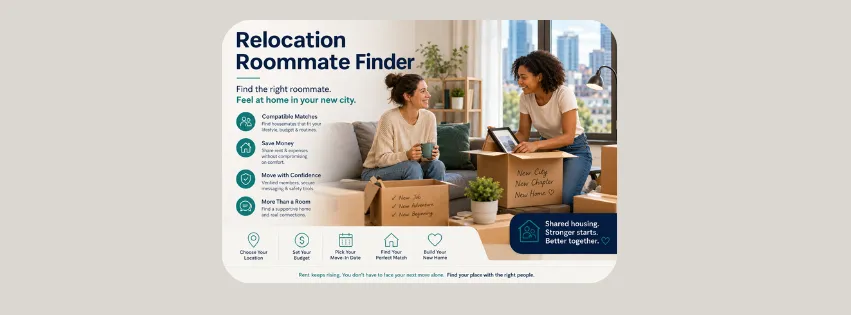
How a Relocation Roommate Finder Helps You Settle
A new job offer can look exciting until you start pricing apartments in an unfamiliar city. Between deposits, moving costs, utilities, and the pressure to choose a neighborhood quickly, relocating alone can make housing feel like the hardest part of the move. A relocation roommate finder gives you a more intentional path: find someone whose budget, routines, household needs, and expectations make sense alongside your own.Shared housing is not simply a way to split rent. For many people, it is a practical way to arrive in a new place with more financial breathing room and a more supportive home base. The right match can make a transition feel less isolating. The wrong one can add stress when you need stability most.Why relocation calls for a different roommate searchWhen you are already local, you can visit neighborhoods, ask friends for recommendations, and take your time comparing options. A relocation often compresses that process. You may be managing a start date, a lease ending elsewhere, children changing schools, or a move prompted by a life transition.That urgency can make an open room listing look like the fastest answer. But a lower monthly price does not tell you whether the household works for your schedule, comfort level, or responsibilities. A night-shift nurse and an early-rising remote worker may share a budget range while needing very different home environments. A single parent may need to discuss children, school routines, guests, and quiet hours before deciding whether a household is a fit.A relocation roommate finder is most helpful when it looks beyond the room itself. It creates space to compare the details that shape daily life, including preferred location, move-in timing, budget, work routines, cleanliness expectations, pets, smoking preferences, and household communication styles.Start with the home life you needBefore searching, define what would make your next home feel workable. This is not about creating a perfect wish list. It is about knowing which needs are nonnegotiable and where you can be flexible.Begin with the practical limits: your target monthly contribution, the latest move-in date you can manage, commute boundaries, and the amount you can set aside for deposits and moving expenses. Be honest about total housing costs, not rent alone. Utilities, parking, internet, shared supplies, and transportation can change the real cost of an arrangement.Then consider your day-to-day needs. Do you work from home? Need a quiet space after a late shift? Have a pet, child, or accessibility consideration? Prefer a calm household, or want a home where housemates occasionally share meals and conversation? None of these preferences are unreasonable. They are the information that helps prevent avoidable mismatches.It also helps to separate preferences from deal breakers. You may prefer to live near restaurants or a park, but need a home within a specific school district. You may enjoy a social household, but need clear guest boundaries. The clearer you are with yourself, the clearer you can be with potential housemates.Create a profile that attracts the right peopleA good profile does more than announce that you need a room. It gives compatible people enough context to see whether a conversation is worth starting.Share your intended move date, general location, budget range, and what type of arrangement you are seeking. Add a straightforward description of your routine and household style. For example, a relocating professional might explain that they work hybrid hours, value a clean common area, and are looking for a steady six- to twelve-month arrangement. A parent might state that they are seeking a family-aware household with predictable routines and respectful communication.You do not need to disclose every personal detail to be genuine. Protecting your privacy is part of searching wisely. Keep sensitive information such as financial account details, identification numbers, and your exact current address off a public-facing profile. Share more only as trust builds and as it is appropriate to the stage of the conversation.The Co-Living Matrix lets members create free profiles around their housing needs, lifestyle preferences, and housemate criteria, so matches can begin with more than a vague location and price point.Compare compatibility before committingCompatibility does not mean you and a potential housemate have identical habits. It means the differences between you are understood, discussed, and manageable.Once you find a promising match, move past general questions quickly. Ask how bills are typically divided, how the household handles cleaning, how often guests visit, and what quiet hours look like. If one person is offering a room, ask about the existing lease, move-in requirements, parking, storage, and whether everyone in the household agrees to the arrangement.For parents, the conversation should also include household boundaries around children. Ask whether the home has age-appropriate space, what the morning and evening schedule is like, and how shared areas are used. For empty nesters or adults after a major life change, it may be especially important to discuss privacy, overnight guests, and whether the home feels calm rather than temporary or crowded.Pay attention to how someone answers, not just what they say. A compatible person can usually discuss expectations directly and respectfully. If they dismiss reasonable questions, pressure you to decide immediately, or avoid basic details about the home, treat that as useful information. A move deadline is real, but it should not require you to ignore your instincts.Keep the search secure while you are at a distanceRelocation can make people more vulnerable to misleading listings and rushed decisions. You may not be able to tour a home in person right away, and photos alone cannot confirm the condition of a space or the dynamics of a household.Use privacy controls and secure in-platform messaging when available, especially early in the process. Keeping initial communication in one place makes it easier to maintain boundaries and notice whether someone is consistent in what they share. Verification features and reporting tools can add useful structure, but they do not replace your own judgment.Before making a commitment, arrange a live video call. Ask for a real-time walkthrough of the room, shared spaces, entryways, and any areas that matter to your decision, such as a home office setup, laundry area, or parking. Confirm who lives there and who will be named on any agreement.Never send money because someone says another renter is waiting. Review the lease or written house agreement carefully, understand what a deposit covers, and make sure payment terms are clear. If possible, see the property in person before signing. When that is not possible, consider a short-term arrangement that gives you time to learn the area, provided the terms are documented and you are comfortable with them.Talk through the agreement, not just the move-in dateA successful shared home depends on the conversations that happen before the boxes arrive. Rent is only one part of the agreement. Discuss utilities, payment timing, cleaning responsibilities, shared supplies, parking, pets, guests, noise, and how either person would handle an early move-out.Written expectations are not a sign of distrust. They are a way to protect both people from misunderstandings. If you are moving into an existing home, make sure you understand whether you are joining a lease, subletting, or entering a separate agreement with the current tenant. The platform that introduces you is not your landlord, broker, or party to the housing agreement, so it is your responsibility to review terms and seek appropriate guidance when needed.For a household with children, put extra care into practical routines. Decide which spaces are private, how shared areas are kept safe and organized, and how schedule changes will be communicated. A thoughtful agreement gives everyone a clearer foundation, whether the household lasts a few months or several years.Give yourself permission to choose carefullyThe best relocation choice is not always the closest apartment or the lowest advertised rent. Sometimes paying slightly more for a better location, clearer agreement, or more compatible housemate reduces stress and unexpected costs later. Other times, a short commute matters less than a quieter household and enough space to reset after work.Take the search one step at a time: create a clear profile, review compatible matches, communicate within boundaries, and verify the arrangement before you commit. Rent keeps rising, but you do not have to face a major move alone. A carefully chosen shared home can give you room to settle in, save money, and begin the next chapter with greater confidence.
Cut Your Rent in Half Safely.
Match with background-screened, ID-verified housemates today.
Find Roommates FreeHave a Spare Room or Property?
Fill vacant rooms with verified co-living occupants.
List Your Property →